
Author: Danyelle Khmara
A University of Arizona governance body plans to investigate campus police use of license plate-reading technology and how that data is shared with other law enforcement agencies.
Records show the University of Arizona Police Department searched a national license-plate database on behalf of a federal agency — contradicting a university official’s claim that the department wasn’t sharing that data with the federal government.
UAPD participated in a national network for sharing data collected on automated license plate readers, or ALPRs, which use cameras to capture computer-readable images of license plates. That data is maintained by a manufacturer called Flock Safety.
In recent months, concerns have grown nationwide that Flock Safety’s ALPRs and information-sharing networks pose significant threats to personal privacy and could aid immigration enforcement under President Donald Trump’s mass-deportation efforts.
At an Oct. 9 public forum, University of Arizona Chief Safety Officer Steve Patterson addressed concerns, saying, “Let me be clear — The University of Arizona is not sharing this information with any U.S. government agency.”
But documents obtained through a public records request show that UAPD conducted searches for the U.S. Marshals Service earlier this year.
Committee to investigate university use of ALPRs
University of Arizona’s Faculty Senate is convening an ad hoc committee to investigate its contract with Flock Safety and other physical surveillance issues, according to Chair Leila Hudson.
Hudson said last week that recent revelations about the automated license plate readers have raised concerns in the community.
“Technological advances in surveillance have the capacity to outstrip our awareness of them and thus imperil civil liberties and data privacy,” she said in a statement. “A lack of transparency around these systems creates an environment that can incubate abuse and mistrust.”
While the Fourth Amendment protects people from unreasonable search and seizure, courts have not yet clearly determined how those protections apply to newer surveillance technologies, such as ALPRs, according to a Congressional Research Service report.
Instead, states have adopted a patchwork of laws that offer varying levels of protection, according to state statutes compiled by the National Conference of State Legislatures.
Hudson said the ad hoc committee that the Senate is convening will include students, staff and community members who will investigate the surveillance systems. The committee will then make recommendations on best practices that safeguard civil rights, she said.
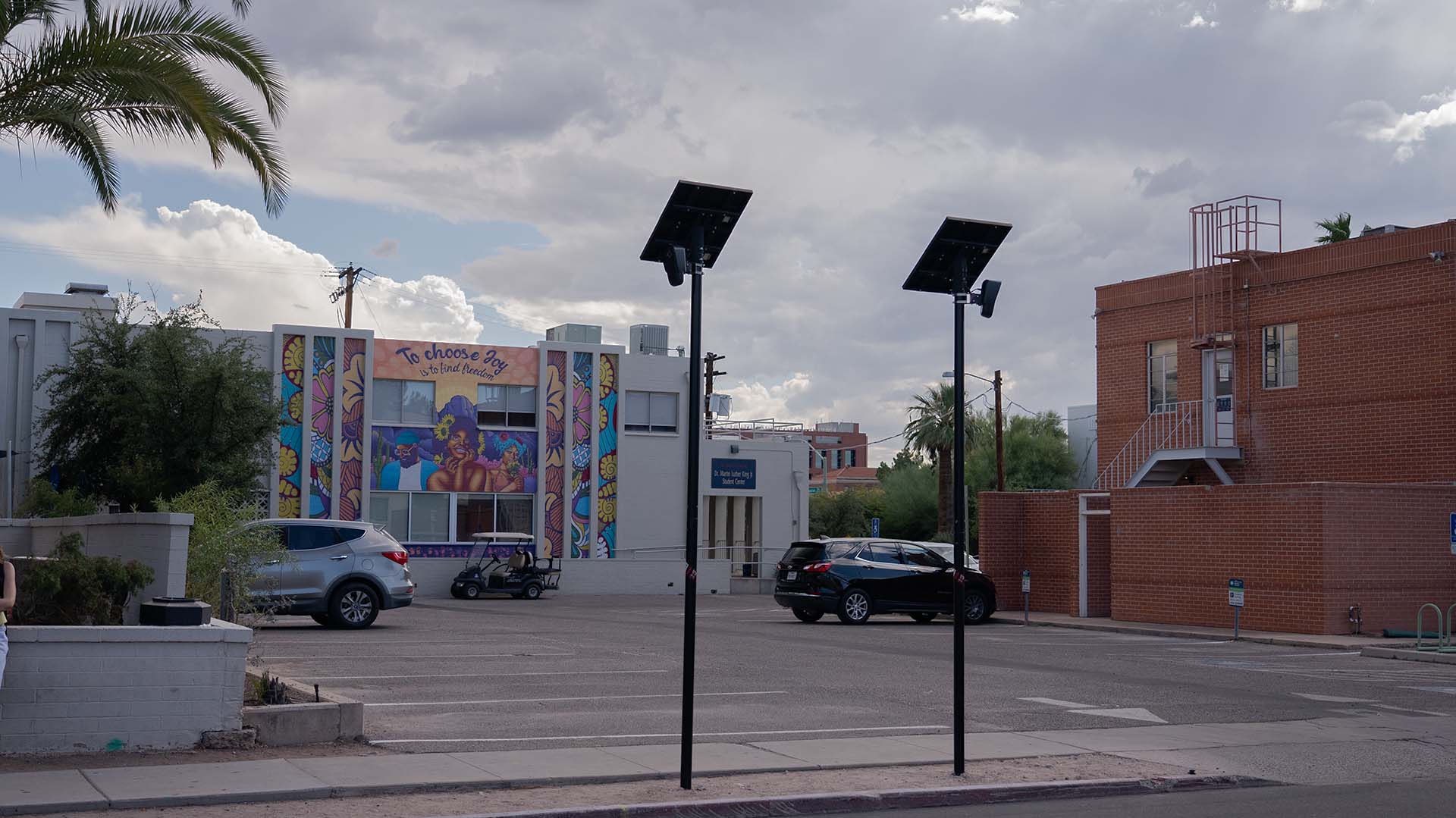 Two automatic license plate recognition cameras on 1st and Mountain on the University of Arizona campus.
Daniel Ramirez / AZPM News
UAPD does national search on behalf of U.S. Marshals
Data that the Electronic Frontier Foundation obtained and shared with AZPM show that UAPD searched tens of thousands of Flock Safety devices throughout the country on behalf of the national law enforcement agency, in February and March.
The U.S. Marshals Service serves as the enforcement arm of the federal courts. It is responsible for protecting judges, apprehending fugitives, running the Witness Security Program, managing seized assets, and providing security for federal courthouses and officials.
UAPD spokesperson Andrew Valenzuela said the requests were instances where an investigator ran license plate searches for the U.S. Marshals Service as part of violent-crime investigations and to see whether the related vehicle had been on campus.
He maintained that the database searches that the police agency conducted for the U.S. Marshals Service are consistent with university policy.
A representative for Flock Safety said that federal agencies don’t have access to the full national network, which would be illegal in some states where the technology is present. The federal government can, however, ask local agencies to share data with it and do searches on its behalf.
UAPD’s search on behalf of a federal agency sheds light on one of the ways federal law enforcement can access the data even if they don’t have direct access to the national sharing database.
Since Oct. 1, UAPD policy requires written approval from the criminal investigations commander ahead of any data or records sharing from any of its about 60 automated license plate readers.
Dave Maass with the Electronic Frontier Foundation said that law enforcement across the country are frequently searching on behalf of other agencies, including federal law enforcement and immigration authorities. So if departments are part of a national database, it’s hard to know if federal agencies are accessing it secondhand, he said.
“Unless you are limiting it to a much, much smaller group of officers that you know and trust and who have all signed an agreement not to share it with the federal government,” he said.
‘We don’t have an agreement on what a crime is anymore’
UAPD confirmed to AZPM that before implementing the policy to regulate its dozens of Flock devices, its license plate reader data was shared with other agencies across the country “to support public safety and criminal investigations.”
When law enforcement agencies search Flock’s national database, they are required to provide a reason for the search. But according to Maass, that requirement offers limited protection against misuse once data is shared across state lines, because what qualifies as a public safety concern or a crime is not consistent from state to state.
“This idea that crime is a universal thing that we all agree upon is total baloney,” he said. “Cannabis is legal in some states, it’s not legal in others. Abortion: legal in some states, illegal in others. Gender affirming care: illegal in some states, not illegal in others. Being undocumented: illegal in some places, protected in others. There’s just a whole long list where we don’t have agreement on what a crime is anymore.”
For example, Texas has strict abortion bans, which differs from other states.
Johnson County Sheriff’s Office, a jurisdiction 30 minutes south of Fort Worth, Texas, made headlines in May when 404 Media reported that they conducted a nationwide search of more than 83,000 Flock ALPR cameras. Deputies searched “had an abortion, search for female.”
According to court records and documents later obtained by the Electronic Frontier Foundation, the search was conducted as part of an abortion-related death investigation. EFF reported that deputies logged evidence of a self-managed abortion and consulted prosecutors about whether charges could be filed, though the district attorney ultimately determined the woman could not be charged under Texas law.
Reporting by EFF said ALPR networks searched by the Johnson County sheriff included cameras in Illinois, a state where abortion access is protected by law. In response, the Illinois Secretary of State took action to limit out-of-state use of the surveillance data.
Records show that the Johnson County Sheriff’s Office and UAPD were in the same data-sharing national network at that time. A network audit of the Johnson County Sheriff’s ALPRs shows UAPD conducted searches across tens of thousands of cameras, including the Texas sheriff’s department, dozens of times between January and July.
Common reasons they provided for the searches included: “investigation,” “home invasion robbery,” “criminal damage,” “fugitive,” “suspicious vehicle,” “vehicle” and “homicide.” Some searches listed only numeric identifiers as their justification, which appear consistent with police case numbers. UAPD did not respond to a question on what the numeric identifiers represent.
 Deflock Tucson
Leave a Reply