
Attribution: https://breakthroughnews.org/flock-safety-surveillance-authoritarian-tracking-infrastructure-drones-alpr/
Author: Julia Luz Betancourt
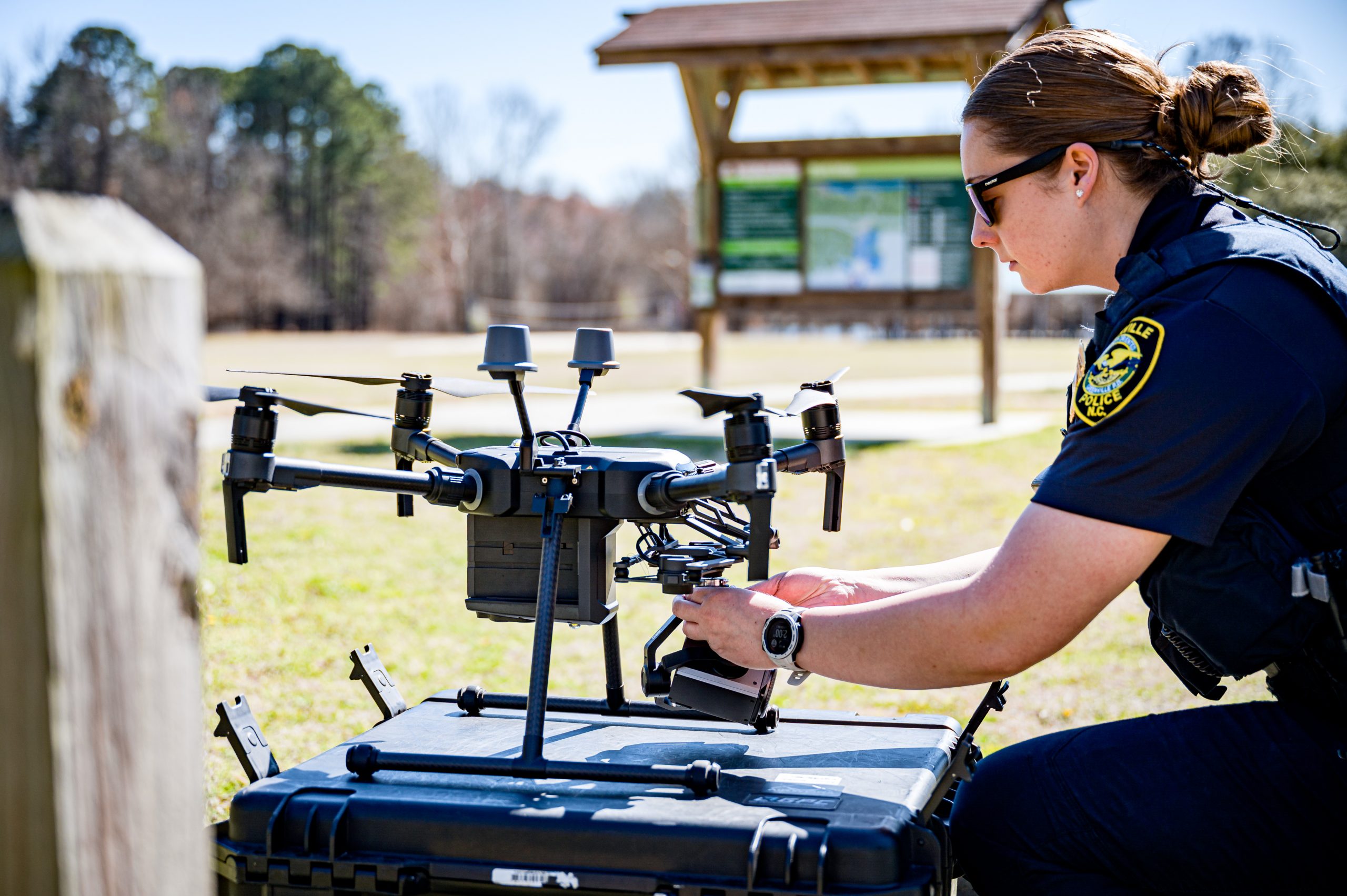
GPD DroneGreenville Police’s Technology Officer A.F. Frasure demonstrates the department’s DJI Matrice drone on Wednesday, March 2. Original public domain image from Flickr
Flock Safety was once a small technology startup with a mission to solve and “eliminate” non-violent crime. Today, it’s one of the largest providers of automated license plate readers in the United States, and is building a vast network of live video cameras and audio detectors that may already be surveilling the majority of people living in the U.S.
Since Flock was founded in 2017, its value has risen to $7.5 billion and, like its profits, its surveillance capabilities are growing.
Through its “aerodome” system, Flock deploys Drones-as-First-Responders that can be immediately dispatched to a person’s geolocation and alert local law enforcement of their whereabouts in real time. If the battery on one drone dies, another will rise from a compartment to take its place in the sky.
Beyond Flock’s hardware is an intricate surveillance database that collects and stores footage from the cameras it has stationed all over the country. In 2024, its Chief Executive Officer estimated Flock’s surveillance network spanned nearly 70% of the U.S. population.
“If you think that you can…keep that data out of the hands of the Trump administration, you should think again.”
The database has already been used to track a woman across state lines who police said had a self-administered abortion, conduct immigration-related searches including on behalf of Immigration and Customs Enforcement (ICE), and let Customs and Border Protection (CBP) tap into more than 80,000 cameras nationwide. As of 2024, a police chief and a lieutenant in two separate Kansas jurisdictions were discovered to have used Flock cameras to track and stalk their former intimate partners.
Flock’s database “gives broad-reaching, mass surveillance power to even the smallest town’s police chief,” said Jay Stanley, a senior policy analyst at the American Civil Liberties Union (ACLU) who has written about Flock for years. “If you think that you can…keep that data out of the hands of the Trump administration, you should think again.”
Profit Over Privacy
With Donald Trump’s return to the Oval Office, several federal agencies like the Internal Revenue Service, Social Security Administration and Department of Homeland Security are using data as a weapon to track immigrants for mass deportation.
But federal agencies are not the only ones capable of mass surveillance. Private companies like Flock—once focused on serving a particular purpose like solving non-violent crime—are now building a mass surveillance infrastructure designed to surveil communities everyday.
“Like so many companies getting rich off selling surveillance and technology to police, [Flock] is a wealthy company that, above all else, has a profit motive,” said Matthew Guariglia, senior policy analyst at the Electronic Frontier Foundation (EFF), a nonprofit focused on defending people’s civil liberties in the digital world. “Flock has the capacity to become a one-stop shop for local, state, and federal [officials] who want to upend civil liberties,”
Flock now markets itself as a means to eliminate “all crime,” and is fusing its technology with data brokers and corporations, even going so far as to develop “people lookup tools.”
“These devices are all networked together and that consolidation of information over time is certainly a troubling invasion of a person’s rights,” Guariglia said. “Consolidation of data means an increased ability to track someone’s every move whether they’re in their car, on foot, having a picnic, or marching in a protest.”
In a report published by the ACLU in August, Stanley wrote Flock’s technology creates an “authoritarian tracking infrastructure,” which has the potential to be used by the government and by corporations against immigrants, abortion-seekers and activists.
“With multiple ALPRs, police could track a person as they move in their car throughout the day just as they might with an unwarranted GPS device stuck under the hood of a car,” Guariglia said. “But this is every car, all the time.”
“A police officer anywhere in the U.S. can access your data,” Stanley told BreakThrough News.
The exact number of Flock cameras implemented across the U.S. is not known to the public. But hundreds of cameras have been installed in several cities, including Norfolk, San Francisco, and Tulsa, amongst others.
In 2019, Flock’s head of marketing expressed a desire for the company to install cameras on “every street corner.” Yet the company doesn’t seem to want the general public to know just how vast its network has become.
In January, Flock sent a cease-and-desist order to an open-source mapping project known as DeFlock, which provides a free, digitally interactive map of known locations of automated license plate readers (ALPRs) throughout the U.S., including those that belong to Flock. EFF is now representing DeFlock’s creator.
“With multiple ALPRs, police could track a person as they move in their car throughout the day just as they might with an unwarranted GPS device stuck under the hood of a car,” Guariglia said. “But this is every car, all the time.”
A lack of state regulations means communities have had to defend themselves against Flock’s expansion into their cities, with residents asserting that the company’s cameras violate the Constitution.
But Trump’s rise to power has backfired for Flock in some ways. As federal immigration agencies turn to Flock’s license plate readers as a means for tracking immigrants, they’ve sparked a new wave of opposition toward Flock and its technology.
In 2023, police installed 172 Flock cameras in Norfolk, Virginia, making it “functionally impossible for people to drive anywhere without having their movements tracked, photographed, and stored in an AI-assisted database,” a lawsuit alleges. The lawsuit argues this violates the Fourth Amendment, which prohibits unreasonable search and seizure.
Flock’s website states that the company’s systems are designed to “respect both the spirit and the letter of the Fourth Amendment and guard against unreasonable search and seizure.” But the company provides little evidence to support this claim.
Flock says it is the first company to “create a free ALPR transparency portal,” which makes a customer’s ALPR usage publicly available. The portal is optional for customers.
Similarly, Flock’s audit reports are not immediately publicly accessible. Previous reports revealing that Flock cameras were used for immigration enforcement were discovered through public records requests—which can be denied by agencies.
Meanwhile, Flock admits that law enforcement has “full control over how they utilize the Flock system.” That includes who they share data with, how they use that data, and whether or not they implement any protocols for using Flock technology.
Flock did not respond to a list of questions from BreakThrough News regarding allegations that its technology creates an “authoritarian tracking infrastructure” or whether the company has created specific parameters to prevent its technology from being used for immigration enforcement or tracking those who receive abortions.
Billionaire-Backed
Flock’s approach to growth mimics the strategy of one of its major investors.
In March, the company secured a $275 million investment package spearheaded by venture capital firm Andreessen Horowitz—better known as a16z—which Flock will use to build a manufacturing plant and expand its drone products.
a16z has spent millions of dollars lobbying Congress to support advances in AI and defense technology. Its co-founder—Marc Andreessen—wrote a manifesto in 2023 that claimed “there is no material problem…that cannot be solved with more technology.”
The manifesto lays out a vision for society where technology companies can practice endless development, advancement and expansion with little regulation.
During the same year the manifesto was published, a16z’s other co-founder, Ben Horowitz wrote an article announcing the firm would “get involved with politics” for the first time by funding the campaigns of candidates who align with a16z’s vision “specifically for technology.”
Andreessen and Horowitz—who are both billionaires—each poured $3 million into MAGA Inc., the superPAC which supports Donald Trump, during the 2024 presidential race. Andreesen announced in December he had spent “half” his time at Mar-a-Lago in the weeks after Election Day discussing policy with Trump.
“The only way to stop this transformation of our public spaces is for communities to rise up and organize.”
But Trump’s rise to power has backfired for Flock in some ways. As federal immigration agencies turn to Flock’s license plate readers as a means for tracking immigrants, they’ve sparked a new wave of opposition toward Flock and its technology.
City council members in Austin, Texas refused to renew their contract with Flock as a result of its collaborations with ICE. “Austin should not be participating in Trump’s mass surveillance programs,” said council member Mike Siegel.
Similarly, Denver, Colorado’s city council rejected a newly proposed Flock contract in a unanimous vote, citing new community concerns with the technology and the Trump administration’s plans to prosecute local elected officials who obstruct ICE enforcement.
“This kind of surveillance technology is a gift if you have that kind of ill intent,” council member Sarah Parady said. “The federal government has that ill intent right now.”
Yet as legislators nationwide have yet to implement strong protections against Flock technology, Stanley emphasized the need for sustained local resistance.
“There are no signs that Congress is going to take action on this anytime soon,” he said. “The only way to stop this transformation of our public spaces is for communities to rise up and organize.”
 Deflock Tucson
Leave a Reply